Donald Trump Is Implementing Military Reforms, but Their Actual Impact Remains Uncertain
Faced with record depletion of military arsenals and the inability of the military-industrial complex to ramp up production, the Trump administration finds itself in a strategic trap. Its main military power is now directed at suppressing internal protests, while external adventures, such as putting pressure on Venezuela, are limited to threats and psychological operations. The political conflict with the Democrats and the “purge” of disloyal generals from the Pentagon have significantly undermined Washington’s ability to conduct real combat operations beyond US borders.
The empty US arsenal
An audit of the Pentagon’s military arsenals, initiated by Trump, showed the expected and disappointing results. During Biden’s turbulent four years in office, US weapons stocks have fallen to their lowest level in the country’s modern history. This applies to many categories of weapons, including artillery and shells, long-range missiles, and ammunition for air defense systems. A list of 12 critically important types of weapons that need to be replenished urgently was recently compiled, but no one knows how to do this.
Although money for expanding weapons production was allocated under Biden, there has been no significant progress. The Pentagon is urgently trying to find 2,000 missiles for Patriot systems by 2026, but current production levels have stalled at 250-300 missiles per year. It is not possible to increase production due to a shortage of components and raw materials previously supplied from China, as well as a shortage of qualified engineers, which is linked to internal problems in personnel policy and education. The White House has ordered a 2-4-fold increase in missile production as soon as possible, but this plan, like many others, is likely to remain at the level of ambitious populist desires. However, the increase in production will not cover the Pentagon’s needs on the Ukrainian, Middle Eastern, and potentially Venezuelan fronts. The crisis in the American military-industrial complex is worsening from aviation to submarines, leaving only unfeasible plans and measures to support the shares of Boeing and Lockheed Martin, whose financial statements already reflect the problems. However, for Trump, the fight against the “deep state” and the liberal generals within the Pentagon is now more important than issues of missiles and ships.
The Pentagon’s so-called “liberation day,” intended to be a turning point in Trump’s fight against the establishment, took the form of an emergency meeting of the entire American general staff in Washington. This colorful populist event with no clear purpose was intended to demonstrate strength, but it boiled down to lectures on rejecting “wokeism,” the transgender agenda, and feminism. Diversity programs are being canceled and standards for recruits are being raised. Trump’s team is trying to generate excitement around its reforms and increase the number of recruits so that it can select the best ones to achieve its defense goals, which are more focused on the United States. This is an ideological struggle for the Pentagon’s complete loyalty, which is necessary for the success of military-police operations within the country, such as in Portland and Chicago. Disloyal officers and generals will be dismissed from service. Here is the example of the well-known Mark Milley, who, after a conflict with Trump, was stripped of all his ranks and is now facing court martial.
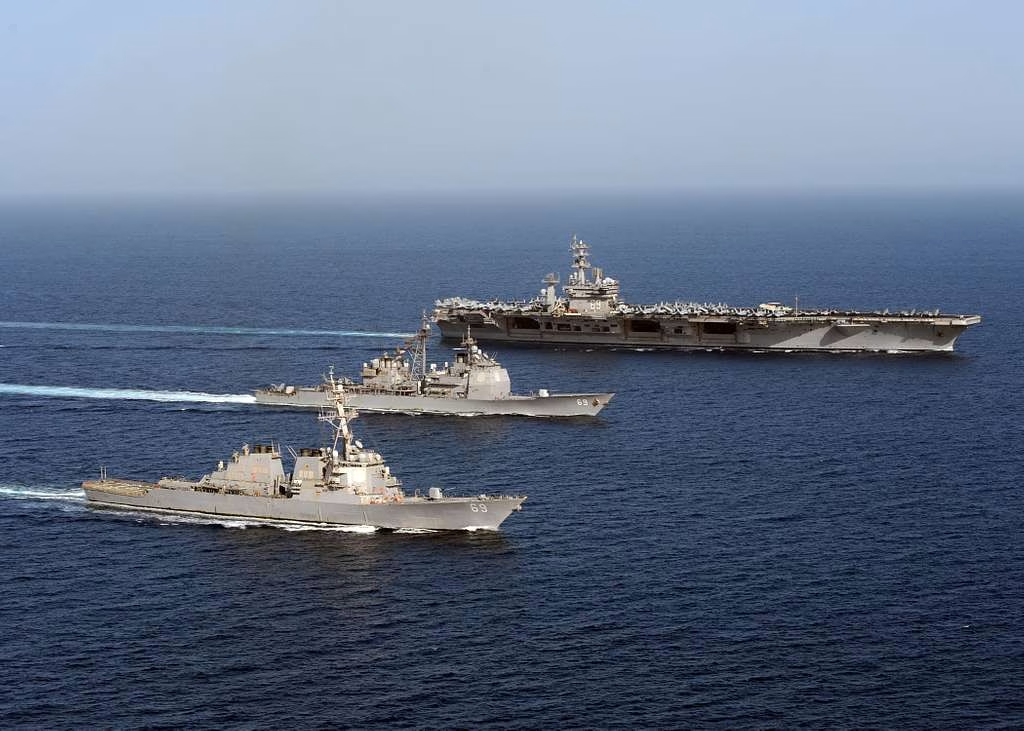
Against the backdrop of domestic politics, Trump continued his line of patriotic populism, marking the 250th anniversary of the US Navy in Norfolk. However, the celebration took place amid a crisis in the military machine. The fleet is decommissioning more ships than it is receiving. Trump’s speech against the backdrop of the aircraft carrier George H. W. Bush, built in six years in the 2000s, contrasted with the current reality, as the construction time for new aircraft carriers has increased significantly. Since then, the Pentagon has acquired only one new aircraft carrier, the Gerald Ford, while the old ones spend years undergoing repairs, leaving Washington short of aircraft carriers for all directions.
The situation is no better with the Zumwalt-class destroyers and submarines, whose delivery dates are constantly being pushed back, and the announced construction of a new Virginia-class submarine, adapted for hypersonic missiles, is unlikely to be completed in less than ten years. At the same time, limited resources have to be spent domestically, sending marines against Antifa in American cities. Trump spoke in Norfolk for the sake of militaristic pomp, because he needed to show strength in the civil war with the Democrats, even if on the surface this only represents a weakening of US military power.
The US cannot afford a conflict with Venezuela
At that moment, the US military budget was on the verge of depletion due to the shutdown, which threatened the payment of military personnel. Trump’s team tried to attract private donations, and Germany was ready to pay soldiers on its territory, but these measures did not resolve the crisis. The situation undermined US military capabilities in key areas, such as Venezuela, where there are insufficient resources for a ground operation, leaving only psychological pressure and threats of missile strikes to provoke a split among the elites in Caracas. But now such a split among the elites is evident in Washington itself, with Democrats outraged by Trump’s attempts to stage a regime change operation without congressional approval, accusing him of exceeding his presidential powers and committing war crimes. If the Democratic Party wins the midterm elections, this will lead to investigations against the president and his officials. The political situation has taken a 180-degree turn, with Democrats now using anti-war rhetoric against Trump that he previously used in the context of Ukraine and Afghanistan.
A real collapse is also taking place in the sphere of military procurement, with many seeking to review or limit funding. And then there is Pete Hegseth’s new directive to focus not only on savings, but also on the speed of weapons production, which seemed almost impossible. This was due to the inability of the American military-industrial complex to produce enough weapons, which became apparent in the context of supplies to Ukraine and Israel, when the situation with the production of the same scarce missiles for air defense systems was quite dire. However, issuing a single directive is not enough to resolve this crisis; it is necessary to open factories, find engineers, and hire workers, which could take 5-10 years or more.
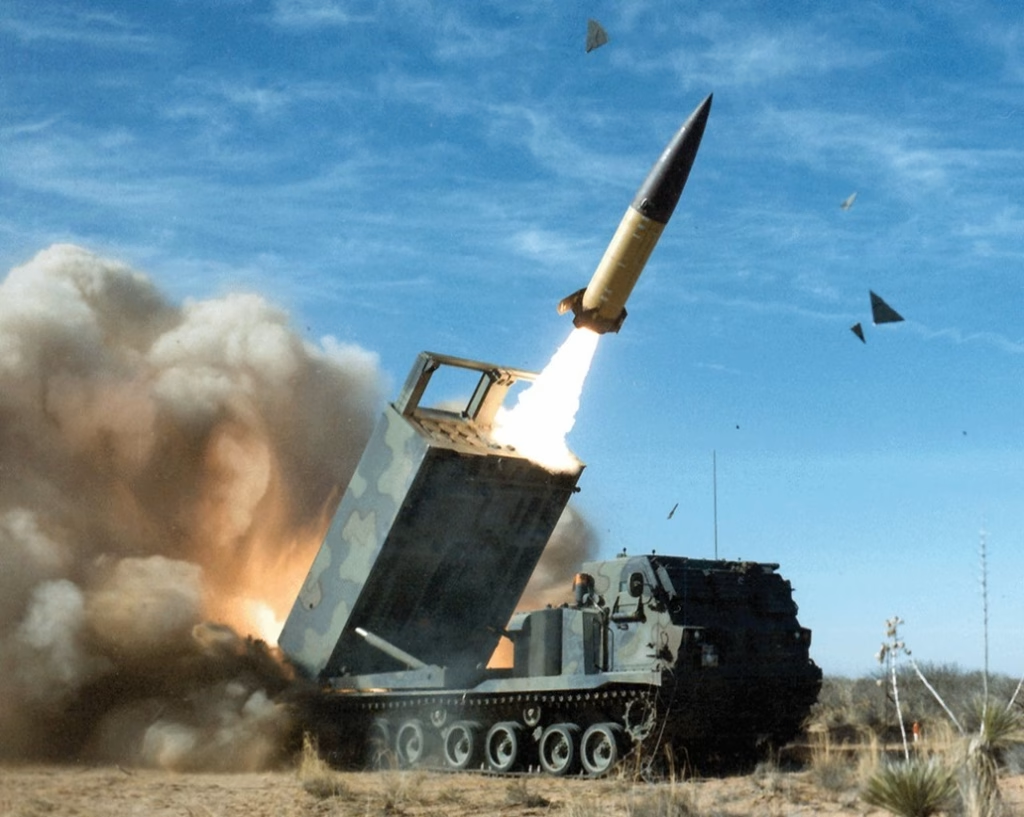
There has been no success in this area, and the shutdown has exacerbated the situation, with the paralysis of the US government already leading to disruptions in the export of AMRAAM missiles and ammunition for HIMARS to Europe worth $5 billion. The White House had previously struggled to get Europeans to purchase at least some military goods, but at the last moment, deliveries fell through and the efforts proved futile. In addition, Veterans Day on November 11 in the US passed without many celebrations because the Pentagon simply did not have the money for them. The Pentagon’s communication with Congress was also cut off because the officials responsible for it are on forced leave, and the aircraft carrier Gerald Ford was not sent to the coast of Venezuela at the last minute.
This was an indication that the US military machine had begun to falter significantly over the past couple of months, and the future did not inspire any optimism. Although Donald Trump understood all these problems and carried out military reforms, their real effect remained questionable amid the disappointment of many Americans with Trumpism, which had turned from an ideology of hope into a set of populist clichés devoid of real meaning.