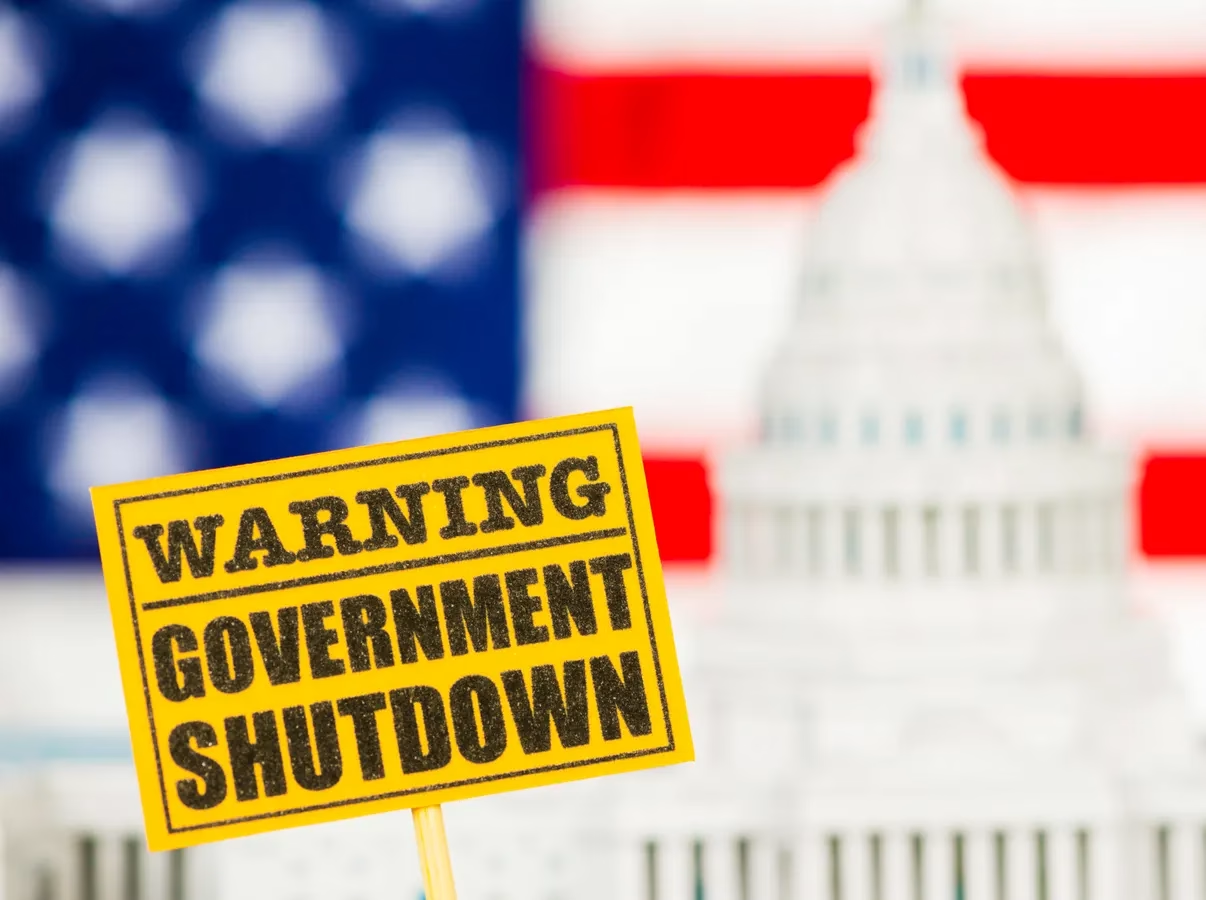
The Longest Shutdown in History Has Exhausted America and Trump
The protracted shutdown has put the Trump administration in an unprecedented deadlock, mirroring Joe Biden’s position on the eve of the election. In an attempt to turn the tide, Trump has adopted left-wing populist rhetoric, declaring a hunt for meat corporations, while his own Republican allies are secretly hoping for a “tariff coup” by the Supreme Court to distance themselves from the president and prepare for the post-Trump era.
Trump has reached an impasse
In early November, Donald Trump desperately tried to end the painful shutdown, and lawmakers loyal to him attempted to quickly reapprove the budget bill and stop the paralysis of the entire government system. However, the chances of success were slim because the Democrats were buoyed by their landslide victory in the recent local elections and were unwilling to compromise. The Republicans, in turn, were also unwilling to give in, because Trump was still suffering from post-traumatic stress disorder after the previous shutdown in 2019, when he had to make a rather humiliating surrender.
As a result, there was a growing sense of déjà vu, as the 2019 shutdown ended amid the threat of air traffic collapse. In 2025, a similar situation arose, with thousands of flights being rescheduled or canceled altogether, and there was even talk of completely closing the airspace over regions of the US due to an acute shortage of air traffic controllers. In October, the first full month of the shutdown, the number of layoffs in the US jumped 175% to its highest level since 2003, which is a huge increase. Even during the 2008 financial crisis and the 2020 COVID-19 pandemic, when air travel plummeted for insurmountable objective reasons, the situation was much easier.
In the coming months, a sharp rise in unemployment is expected, which may be impossible to estimate. So it was clear that sooner or later a budget would have to be passed, and the only question was who in Washington would be the first to crack. The Democrats were confident that it would be Trump, who would once again display his well-known TACO effect, but for Trump, losing face meant further damaging his ratings. It was this stalemate between the two sides that led to the longest shutdown in history, and no one really knew how to get out of this crisis in the US.
Unsurprisingly, against the backdrop of the shutdown, a major corruption scandal erupted over the awarding of government contracts to small businesses in the US, which were allowed to receive government contracts without competition.
Amid the shutdown and budget crisis, Republicans highlighted the problem of large-scale waste of public funds, which had reached a particular scale under the Biden administration. The system of distributing contracts, particularly by the Pentagon, among companies owned by minority representatives without proper verification has been criticized, leading to the emergence of gray schemes involving business fragmentation and outsourcing of work, for example, to India. According to the accusations, tens of billions of dollars are spent annually on these schemes, and undermines the financing and development of new weapons. Similar claims are made regarding social programs, such as the issuance of food stamps and medical subsidies to illegal immigrants. Republican attempts to cut these expenditures were one of the reasons for the budget standoff and shutdown. Although the Senate attempted to partially resume government operations on November 10, corruption scandals are deepening the divide in Washington, nullifying efforts at a truce. Even if the conflict is temporarily frozen, there is a general understanding that this is only a pause before its inevitable resumption.
The White House in search of culprits
As a result, due to the shutdown, which exposed all the accumulated economic problems, Trump found himself at the end of 2025 in the position of Joe Biden during the election period, which he took full advantage of at the time. But now the Democrats are taking advantage of the same situation, as accelerating inflation in the US is forcing the White House to threaten investigations into market participants accused of “price gouging.”
The crisis in the American meat industry has taken center stage, forcing Donald Trump to take a left-wing populist stance similar to the rhetoric of the Democrats. Like Kamala Harris, he has promised to prosecute companies for “price manipulation.” But the real reasons for the price increases are objective: the US cattle herd has fallen to its lowest level in 73 years due to years of farmer losses and a recession in the agricultural market. Instead of solving systemic problems, the administration is looking for someone to blame and publicly punish — and that someone is the largest player, Brazilian holding company JBS, which will be accused of price fixing.
This will also be a tool to put pressure on President of Brazil Lula da Silva, with whom Trump has a tense relationship. At the same time, the White House plans to purchase beef from the loyal President of Argentine Javier Milei, which may temporarily stabilize prices but will deal a blow to American producers. However, for Trump, strategic risks take a back seat to the need to immediately curb the inflation crisis and the consequences of the shutdown in order to avoid a Republican defeat in the upcoming congressional elections.
Sam Altman asks for money
This is important to Trump because it is what his patrons and supporters from the big business sector want. The AI industry, which is experiencing a hidden crisis, has unexpectedly become a supporter of ending the shutdown as soon as possible, needing stability and government support. Sam Altman of OpenAI called on the government to resolve budget issues and then provide the company with extensive federal grants, arguing that this was necessary for strategic competition with China. Despite recently reaching $13 billion in annual revenue and ambitious valuations of $1 trillion, OpenAI is experiencing a shortage of private investment and hopes to become the flagship of Trump’s reindustrialization program. However, real manufacturing revival in the US is facing difficulties, forcing the authorities to bet on the construction of data centers as an engine of the economy.
This strategy is already causing side effects, such as an acute energy crisis in states like Maryland, where the cost of electricity has risen by 200-300% due to data centers, and by 2030 they could consume up to 15% of the country’s total electricity, putting a strain on outdated networks. In the context of the shutdown, which has exposed the need for rational spending, the White House is skeptical about funding requests, recognizing the risks of financial bubbles. The collapse of the AI bubble, symptomatic of which was Nvidia’s loss of $800 billion in market capitalization, threatens a financial crisis, and Washington does not want to exacerbate the situation by recklessly pouring funds into dubious projects.
Moreover, against the backdrop of economic problems and the challenges of the shutdown, where the president once again failed to show will and determination, Republicans in Congress are secretly hoping for a “tariff coup” against the White House with the approval of the Supreme Court, which could ease the financial situation and boost party ratings. Indeed, conservative judges may declare Trump’s tariffs unconstitutional and revoke them by the end of the year, as well as force the return of all tariff revenues. At the same time, the Supreme Court’s decision is unlikely to affect the tariffs imposed on China, but it will radically change Trump’s negotiating track with the European Union, India, Brazil, and ASEAN countries.
As a result, negotiations will have to be conducted on new terms, which will be much less favorable for the US than the current ones, thereby significantly weakening the White House’s position. However, this may at least halt the rise of inflation in the US and slow down the economy’s slide into stagnation and recession. In addition, Congress wants to regain its constitutional right to control foreign trade, and most lawmakers oppose trade wars and will not continue them. Moreover, in such a scenario, American businesses will receive compensation for the duties paid on the eve of the congressional elections, and this could play out positively for the Republicans, because after their recent defeat in local elections, they are already trying to distance themselves from Trump and his policies. Rand Paul in the Senate and Marjorie Taylor Greene in the House of Representatives are increasingly criticizing the White House’s policies, including tariffs, the escalation around Venezuela, and other failures such as the inability to reach an agreement on Ukraine.
As a result, Republicans are attempting to prepare for the post-Trump era, which will become the main party theme in 2026, especially if it ends with a defeat for the Elephants in the midterm elections. It was Trump’s shutdown, the longest in history, which brought these trends to a head and severely exhausted America and its president.
This gave me a lot to think about. Thanks for sharing.
You’ve clearly done your research, and it shows.