The Economy Remains a Sore Point for the US Amid Trump’s Global Reform Plans
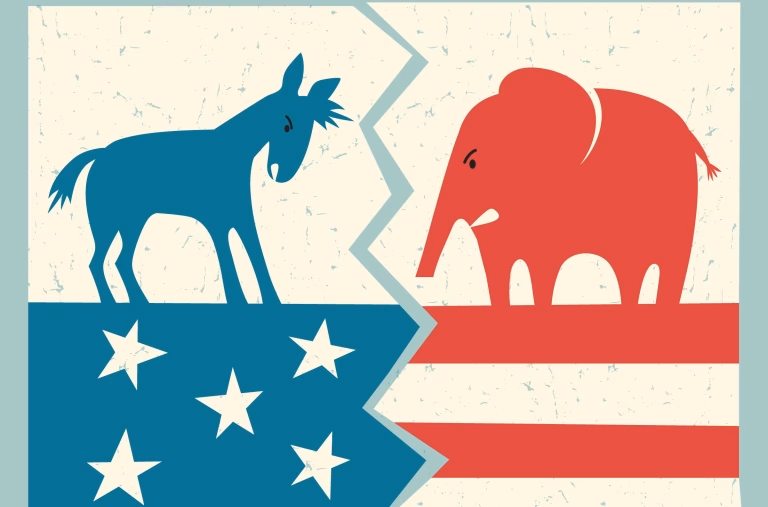
While Trump and the Democrats wage an ideological battle, ordinary Americans are paying the price: the shutdown has crippled air travel, immigration policy has killed jobs, and inflation has exceeded 3% for the first time since the Biden era. Deprived of long-term planning and skilled personnel, the economy is sliding into stagnation, exposing the president not as the savior of the nation, but as a political wheeler-dealer trading the country’s future for short-term victories in the war with his opponents.
Tariffs and immigration raids are killing investment
The confrontation between Trump and the Democrats, which was shrouded in the sacred smoke of an ideological battle that was fateful for America, had a negative impact on the American economy, regardless of the local victory of the right-wing or left-wing discourse. After all, the economy does not like lofty slogans, but recovers only from persistent long-term work, which, after decades of decline, no one wants to do, unlike political squabbles. Thus, the first serious consequence of the recent shutdown was disruptions in air traffic in Los Angeles, Denver, and Newark, reminiscent of the 2019 crisis, but developing more rapidly this year. Air traffic controllers, who were required to work without pay, took sick leave en masse, exacerbating an already critical situation.
With a standard requirement of 15,000 specialists, only 10,000 are employed in the US, which has led to frequent incidents at airports. In 2019, an actual strike by air traffic controllers caused chaos on the East Coast and forced Trump to accept the Democrats’ budget without funding for the border wall. Fearing a repeat of this scenario, Trump’s team dragged out negotiations, and Democrats refused to back down, even though the shutdown cost the economy $15 billion a week. At the same time, the labor market was plunging into crisis due to the threat of mass layoffs of civil servants and the almost complete absence of new jobs amid internal instability. The threat of air traffic collapse, combined with migration problems, dealt an additional blow to the economy and the labor market.

The tightening of migration measures is turning into a serious crisis for Asian corporations. Autumn migration raids at the Hyundai plant under construction in Georgia had a domino effect, and many South Koreans, including those arrested during the raid, began to leave the US en masse. They acted as mentors to American workers and engineers, who often lack the necessary skills because there is a shortage of engineers (1.5-2 million specialists) in the US labor market. The White House also plans to revoke H1B visas for skilled workers from abroad, mainly from India and China. The launch date for the plant in Georgia, which cost $10 billion to build, has now been pushed back, and Hyundai is also suffering billions in losses due to Trump’s 25% tariffs. After all, Korean cars account for about 10% of the US passenger car market, and losing it would be painful for South Korean exporters.
Seoul had previously promised Trump $350 billion in investments if he would lower tariffs on South Korean products, but it will be difficult to invest anything if real production facilities cannot be opened without the help of foreign engineers. And they are now reluctant to come to the US amid migration wars and the current military-police chaos. The situation is even more complicated for Taiwan, which promised $165 billion to build new microchip factories in Arizona. There are similar problems there, which boil down to a shortage of engineers, high production costs, and legal turmoil, compounded by Taiwanese fears that the Americans will simply forget about them once most of the capacity is transferred to the US. As a result, the investment climate in the US continues to deteriorate steadily, and ideas about reindustrialization remain in the realm of fantasy.
The dead end of Trump’s “golden age”
The loyalty of the majority of the country’s peaceful population to the current president is steadily declining. It is now clear that Trump has not only failed to pull the country out of the economic chaos of Joe Biden’s time, but has also driven it into a dead end. Recently, various negative economic phenomena have been exacerbated. Inflation in the US has reached 3% for the first time since Biden’s presidency, and according to some estimates, 3.4%, with a forecast of growth to 4% by the end of 2025. This is due to the delayed effect of tariff wars, rising import costs, and the accumulation of structural problems. The labor market is showing signs of crisis: only 25,000 jobs were created in August, and data for September is unavailable due to the shutdown and mass layoffs of civil servants. The lack of official statistics allows the Trump administration to mask the real state of the economy, but public perception of his policies is negative: his ratings in the economic sphere do not exceed 35-38%.

Democrats are exploiting this situation by stirring up scandal around Trump’s beef deal with Argentina and President Milei. This will hit American cattle farmers, whose market is already in recession, and farmers are a key part of Trump’s electorate. Additional pressure is being created by the expected rise in fuel prices due to anti-Russian sanctions and the escalation around Venezuela. As a result, most people expect the economic situation to worsen next year, and almost 70% are convinced that the “American dream” is dead and that the “golden age” promised by Trump has not arrived.
Trump’s lunar dream against the backdrop of an earthly crisis
This despondency is also evident in the technological sphere. The battle over NASA’s budget has shown that there has been no breakthrough, with business and government simply dividing up the money without any clear practical effect, limiting to populism as they do everywhere else. The real battle has unfolded around the US lunar program, whose goal, set during Trump’s first term, was to return astronauts to the moon by 2024. The deadlines have been constantly pushed back, and now the goal is to achieve this by the end of 2027. For Trump, this is a matter of reputation, a symbol of the return of America’s “golden age,” so he is eager to send the mission before the end of his second term. However, this goal is becoming difficult to achieve due to budget wars and internal problems.
At the same time, Trump’s team has launched a process of disintegrating NASA. The agency’s budget has been cut by a quarter, 12% of its staff — including senior managers and engineers — has been laid off, and the agency itself is now de facto subordinate to the Department of Transportation. Republicans view NASA as an inefficient and politicized structure, which is leading to the collapse of the entire space program. Contracts with SpaceX are also under threat: Elon Musk is being accused of failing to ensure that astronauts can reach the Moon on schedule, as the Starship spacecraft can currently travel only about 150,000 kilometers — far short of the 380,000 kilometers needed to get there. The only alternative is the even more problematic SLS rockets and Orion spacecraft, on which more than $50 billion has already been spent without significant results. Budget deficits and organizational uncertainty continue to hamper the program, delaying any real attempt to return to the moon.
In the US, the crisis manifestations of trade wars, migration policy, and disputes within various spheres will continue to accumulate until the economy begins to collapse. Even the budget compromise that has been reached will not solve all the problems.
These are only temporary measures that cannot overcome fundamental economic difficulties. In this light, Trump will appear to Americans not as a patriot and savior of the country, but as a petty political wheeler-dealer bargaining with his opponents at the expense of the suffering of the population. As a result, the economy remains a sore spot for the US against the backdrop of Trump’s global reform plans, which slows them down and devalues their results.