China Is Steadfastly Repelling Washington’s Attacks in the “Great Trade War” and Appears to Be the Favorite
The APEC summit in South Korea ended with a formal truce between the US and China, which, however, did not resolve any fundamental contradictions — from Taiwan to Russian oil. Beijing, acting according to the formula of “maximum pressure and small concessions,” has achieved concrete steps from Washington, while American threats of nuclear tests have been exposed as a bluff against the backdrop of the crisis of arsenal modernization and divisions within the Trump administration.
China beats Trump at his own game
A week before the APEC summit in South Korea, where the first serious talks between the US and China in a long time could take place, the balance was clearly tipping in Beijing’s favor. The Chinese side approached the summit well prepared, and the Chinese began to use Trump’s own methods against him. China’s policy could be described as a mixture of sharp and unexpected blows, mixed with symbolic concessions on non-principled issues. This is how Trump himself likes to act, seeking to use his “madman strategy” to throw the opposing side off balance, but now the president himself finds himself in a vulnerable position.
The Chinese are focusing on exerting pressure in areas where they have a clear advantage. The same export restrictions on rare earth metals led to a crisis in American industry, with production of a number of car models even being suspended in late spring and early summer this year. At the same time, in other areas, such as the sale of the American business TikTok, Beijing made concessions to Trump, allowing him to declare a symbolic victory. And the situation could soon repeat itself if the Chinese, for example, agreed to partially resume imports of American soybeans, but did not back down on rare earth exports or Russian oil purchases. Beijing’s tough stance has already led to a real rift within the Trump administration. The main anti-China radicals, such as Peter Navarro, have been sidelined because it was understood that their agenda would not end well for the US. China clearly intended to pressure Trump on the issue of Taiwan, demanding that he renounce his support for the island, even though it was understood that this was unlikely to happen because it would cause a real uproar in Washington with cries of complete capitulation to Beijing.
Overall, the White House had high hopes for Trump’s first Asian tour of his second presidential term, but there were obvious problems with it from the outset. At the same time, the maximum program for the Americans was to try to conclude framework trade agreements with China, South Korea, and Brazil. The ASEAN summit in Malaysia could have been the venue for the first face-to-face meeting between Trump and Brazilian President Lula da Silva, who has announced his desire to run for a second term, given his favorable ratings and the possibility of blocking the return to power of Bolsonaro’s supporters, who are closely associated with Trump. However, the meeting did not take place against the backdrop of continuing 40% tariffs on Brazilian goods, despite exemptions for certain categories needed by the US, such as orange juice. Lula da Silva actively criticizes the escalation around Venezuela, demanding that Trump not bring the situation to war, which made negotiations extremely difficult in advance.
The White House demanded $350 billion in investments from formally friendly South Korea, which was an unattainable amount for Seoul. The main focus was on the US-China negotiations at the APEC summit, where Trump was forced to make immediate concessions to secure supplies of rare earth metals and sales of American soybeans. China, in turn, exerted pressure on the Taiwan issue, which forced Trump’s team, despite verbal support from Taipei, to suspend military tranches and cancel Taiwanese President William Lai’s visit to the US. However, these concessions proved insufficient, and the US had to take new steps to mitigate the consequences of the trade war stalemate, which never turned into a real economic “financial cudgel.”
Trump’s shaky truce with China
In the end, a peculiar trade truce between the US and China was inevitable. At the very end of October, negotiators from Washington and Beijing were able to find a compromise and establish a shaky balance of power. At the summit, the parties avoided major contradictions. China continued its tactic of “maximum pressure and small concessions.” Beijing agreed to sell the American business TikTok to Trump’s allies and purchase a batch of American soybeans to support his electorate — farmers in the Midwest — even though most soybean imports come from Brazil and Argentina. In response, the US promised to crack down harder on Chinese opioid precursors, but this measure was ineffective without tackling the cartels, and Trump’s attention shifted to Venezuela. China’s pressure on rare earth metals eased only slightly, leaving Western industry in limbo. The issue of Russian oil was not discussed, and China’s position remained firm. Although appearances were saved, the underlying contradictions remain unresolved, and the next escalation may be close.
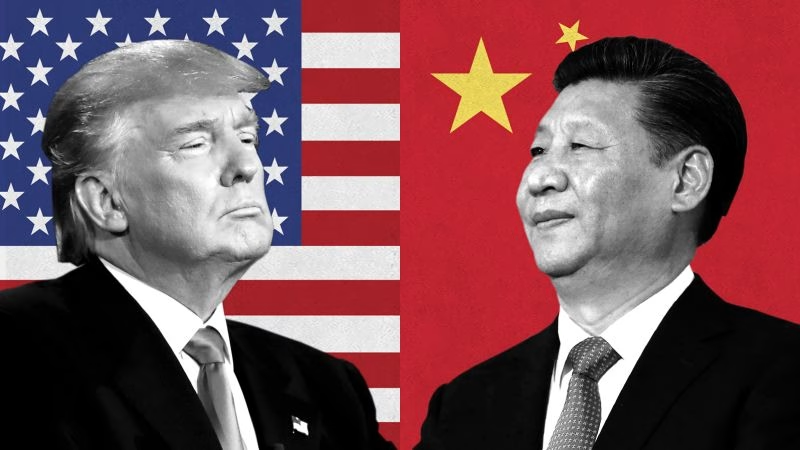
As a result, the meeting between the leaders of China and the US in South Korea took place in a very strange and rather passive-official format. Trump and Xi Jinping praised each other highly ahead of the meeting, but it was held behind closed doors, and neither side was in a hurry to announce the results of the talks. The meeting could well have ended with a freeze on the trade conflict, but there is no reason to talk about a serious de-escalation yet.
Both sides maintained the status quo and sidestepped the main points of tension in their relations, such as the Taiwan issue, although further escalation in the trade sphere cannot be ruled out in the future. Ahead of the summit, Trump’s team also attempted to strengthen its negotiating position by promising to conduct nuclear tests for the first time since 1992, which was a challenge to both Beijing and Moscow.
However, this is also largely a populist move, and it will not be easy to do because the situation with the US nuclear triad remains consistently difficult, and its modernization requires trillions of dollars that are not available. As a result, no new warheads have been added to the Pentagon’s arsenal for a long time, and old ones have to be reassembled and modernized, which is well known to Chinese and Russian intelligence. The previous administration’s promises to resume uranium and plutonium enrichment in the US have remained nothing more than pipe dreams, and the Sentinel program to modernize the old Minuteman III missiles has never really gotten off the ground.
So in the new arms race, the Americans are beginning to lag behind not only Russia, but in some respect also China, which is now investing a lot of effort and resources in its nuclear rearmament. That is why Trump’s statements were just another attempt to bluff, having less than ideal cards in his hand not only in the economic and trade spheres, but also in the military sphere. The bottom line is that we have seen China steadfastly repelling Washington’s attacks in the “great trade war” and looking like the favorite.