Beijing Plays Its Trump Cards in the ‘Silent’ Confrontation With the US
The temporary truce in the trade war between the US and China proved short-lived. In the fall, the conflict escalated amid disputes over Taiwan and rare earth metals. The White House is trying to protect the US economy, but China is steadily strengthening its position in global markets.
Washington, Beijing, and the price of ambition
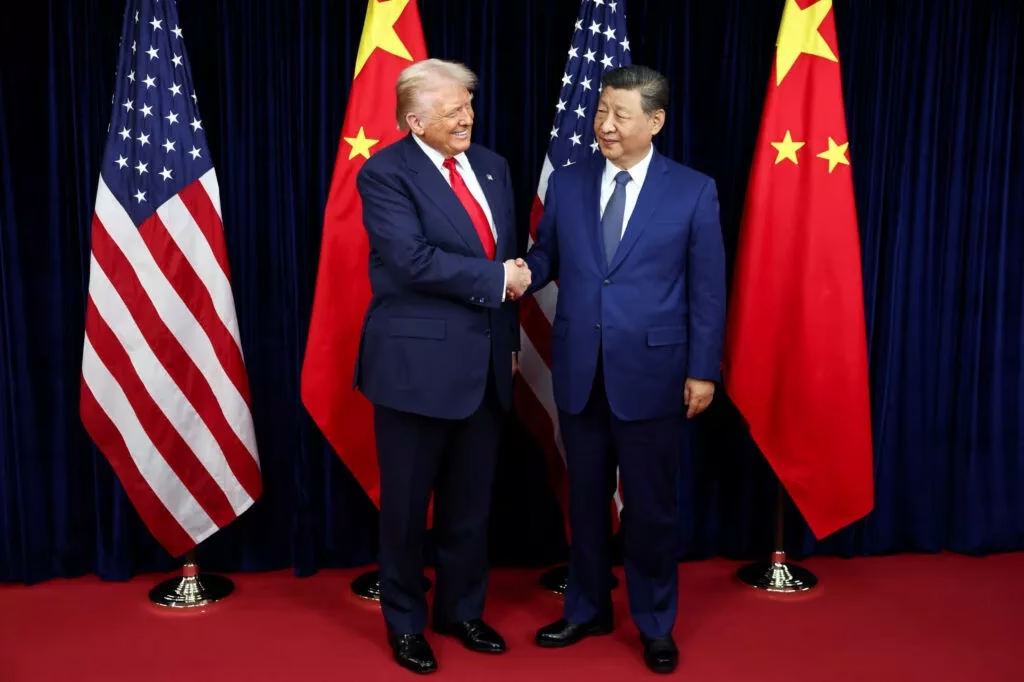
The temporary “truce” in the trade war between Washington and Beijing could not last long. At the beginning of autumn, a new escalation began, and the issue of the island’s independence was put on the agenda of US-China negotiations. The Trump administration was in a hurry to conclude a deal that would mitigate the consequences of the tariff wars for the US economy, and Trump needed it as soon as possible.
Ahead of the holiday season, the US could not allow import prices to rise, while Beijing demonstrated its position of strength, reminiscent of the situation with rare earth metals. China put forward new conditions, including a demand to publicly oppose Taiwan’s independence, while Washington formally adheres to the One China policy but in fact supports Taipei. But the situation is changing. Taiwanese President William Lai was not received in the US, which limited itself to closed-door talks with a lower-level delegation in Alaska, and then the White House suspended $400 million in military aid to Taiwan. Taipei is facing growing pressure to increase defense spending to 5% of GDP and rely primarily on its own security, as Washington increasingly realizes that it cannot win a war with China and is using Taiwan as a political bargaining chip. The island is aware of this and is already demanding a “high price” from the US, refusing to transfer half of its chip production to America until relations with Taipei improve. Calls for more pragmatic relations with Beijing are growing louder, which is not to Trump’s liking, as he is counting on a quick
The US is also unhappy with other once radically anti-Chinese partners. Javier Milei continues to surprise with his political survivability. Recently, he found himself in an almost hopeless situation, with Argentina swept by a wave of protests over corruption scandals in the Milei family, and his party’s defeat in the capital’s elections leading to a financial crisis in the capital. Argentina’s debt markets collapsed again, the peso plummeted, and Milei rushed to seek support from Trump, after which the US allocated funds to stabilize the situation so as not to lose one of its few right-wing allies in Latin America ahead of parliamentary elections. After that, the crisis in Argentina did indeed calm down, and Milei concluded a deal with China to supply 65,000 tons of soybeans, which hurt the interests of American farmers and effectively betrayed an ally in Washington. China previously refused to purchase soybeans from the US due to trade wars, choosing Brazil and now Argentina instead. Despite his pre-election slogans against cooperation with China, Milei changed course as president, sometimes paying the Chinese with barter. He now formally supports Trump, but in fact acts contrary to his course, profiting from the US-China trade war and demonstrating “patriotism.” Washington, meanwhile, continues to easily trade away the trust of its allies for short-term gain, failing to see them as strategic partners.
Rare earth leverage against the US
Similar processes are taking place outside South America. Earlier, chaos and shutdown in Washington distracted the US from events in the Indo-Pacific region. For example, China Mineral Resources Group, the largest importer of iron ore to China, now conducts transactions in yuan, refusing to use dollars when purchasing from Australia. China controls more than half of the world’s steel production, and the key suppliers of ore are Australia and Brazil. With the start of mining in West Africa, China is putting Australians in a difficult position, forcing them to agree to trade in yuan, which accelerates dedollarization and irritates the Trump administration. Relations between Washington and Canberra have become complicated. The terms of the AUKUS agreement are being revised, with the US demanding more funding in exchange for security guarantees, as well as an increase in Australia’s military spending from 2% to 5% of GDP. Australia finds itself caught between the US and China and is forced to maneuver in a difficult situation.
China’s strengths were also evident during the new autumn round of the tariff war, when US financial markets lost $1.5 trillion. Negotiations with Beijing reached an impasse, and China imposed new restrictions on the supply of rare earth metals, causing chaos in logistics and weeks of delays for the chip industry. It is worth remembering that China controls 80% of the rare earth metals market and 90% of the components made from them. In the spring, supply disruptions had already halted Ford’s assembly lines, and the US defense industry found itself under Chinese sanctions, forcing corporations and the Pentagon to recycle old components to extract scarce metals. These new challenges are stimulating the growth of American companies trying to revive the rare earth industry, but they are hampered by a lack of technology, experience, and engineers following large-scale deindustrialization. Prices for rare earth metals in the US have risen by 4,000%, which is seriously complicating Trump’s negotiations with China.
Spies, metal, and controlled chaos
Against this backdrop, anti-Chinese spy mania is growing, sometimes taking very peculiar forms. For example, the US Department of Justice discovered a “Chinese spy” right in the State Department. The accused turned out to be an expert on India and South Asia, who himself is of Indian origin. He was caught passing secret documents to Chinese officials back in 2023. In recent years, the hunt for “Chinese agents” in the US has subsided somewhat, although under Biden, suspects were sought everywhere — from the Navy to New York City Hall and among Chinese political exiles. Under Trump, the first thing they did was disband the Justice Department unit that was searching for foreign agents, as it was also persecuting his supporters, accusing them of ties to Russia.
But the old materials have probably been preserved and are now being used again against the backdrop of escalating negotiations with China. This also provides an excuse for purges in the bureaucracy and the dismissal of diplomats whom Trump does not trust. He has already appointed his political strategist as ambassador to India and curator of South and Central Asia, while old-school diplomats continue to be sidelined. Such a policy is unlikely to help in the dialogue with Beijing, but it increases panic among among the professional bureaucracy because Trump’s team is acting according to the logic of a controlled personnel crisis. Now officials are effectively being pushed to inform on each other, undermining the system from within. As for China, the White House no longer seems to be counting on the possibility of an agreement, and reshuffles among diplomats are no longer capable of changing the course toward confrontation.
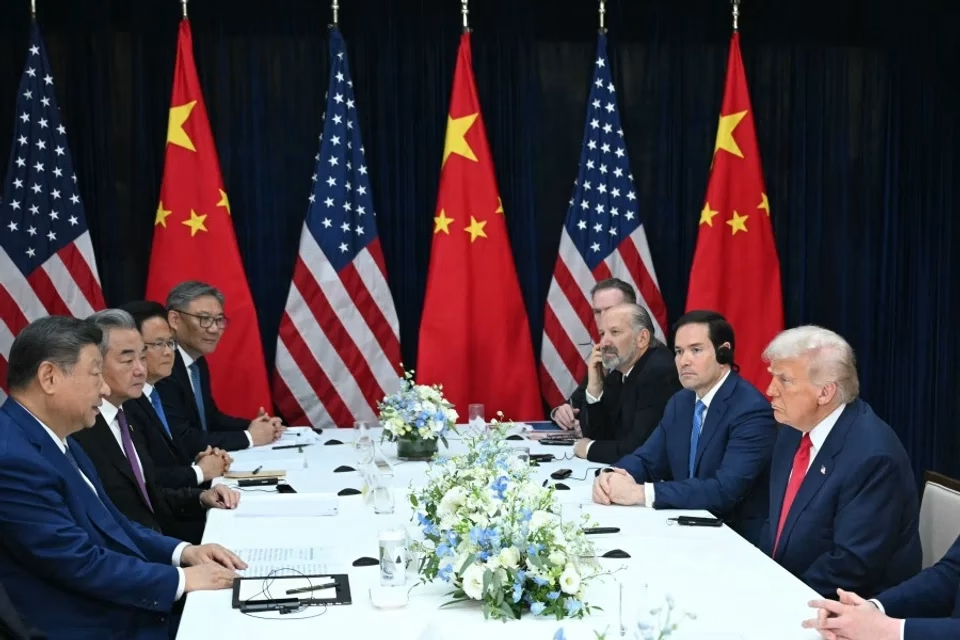
This is evident in Trump’s “rare earth wars,” in which the White House continues to try to reduce dependence on supplies of scarce metals from China to the US. For example, a $9 billion deal was recently signed for the extraction of rare earth metals in Australia. However, these deposits must first be explored and developed. The Australian authorities hope to capture up to 13% of the global rare earth metals market by 2030, but to do so, they will have to take land away from local Aboriginal tribes, who will certainly not be happy about this, causing internal instability in the country and raising the question of abandoning “liberal ideals.”
The US will not be able to catch up with China, which controls the rare earth metals market, but Trump’s plan looks more realistic than previous attempts to revive the industry, although joint projects with Australia raise doubts. Australia is currently a raw materials appendage of China, with many mining projects carried out with Chinese investment and technology, and steel exporters are already being forced to accept the yuan. China could easily make the Australian rare earth industry dependent on it. For now, Trump’s plans are more of a populist media program for negotiations with Beijing.
As a result, Trump would have to ask the Chinese to resume purchases of soybeans from the US, because otherwise farmers in the Midwest would face a new wave of bankruptcies, and they are Trump’s “core electorate.” More importantly, if he failed, the Republicans’ position in the congressional elections would become even more precarious. The desired outcome on the “rare earth issue” would certainly not have been achieved either. Therefore, the failure of Trump’s Asian tour was predetermined. But the US and China will continue their “quiet” confrontation, in which the stakes for Beijing are still higher.