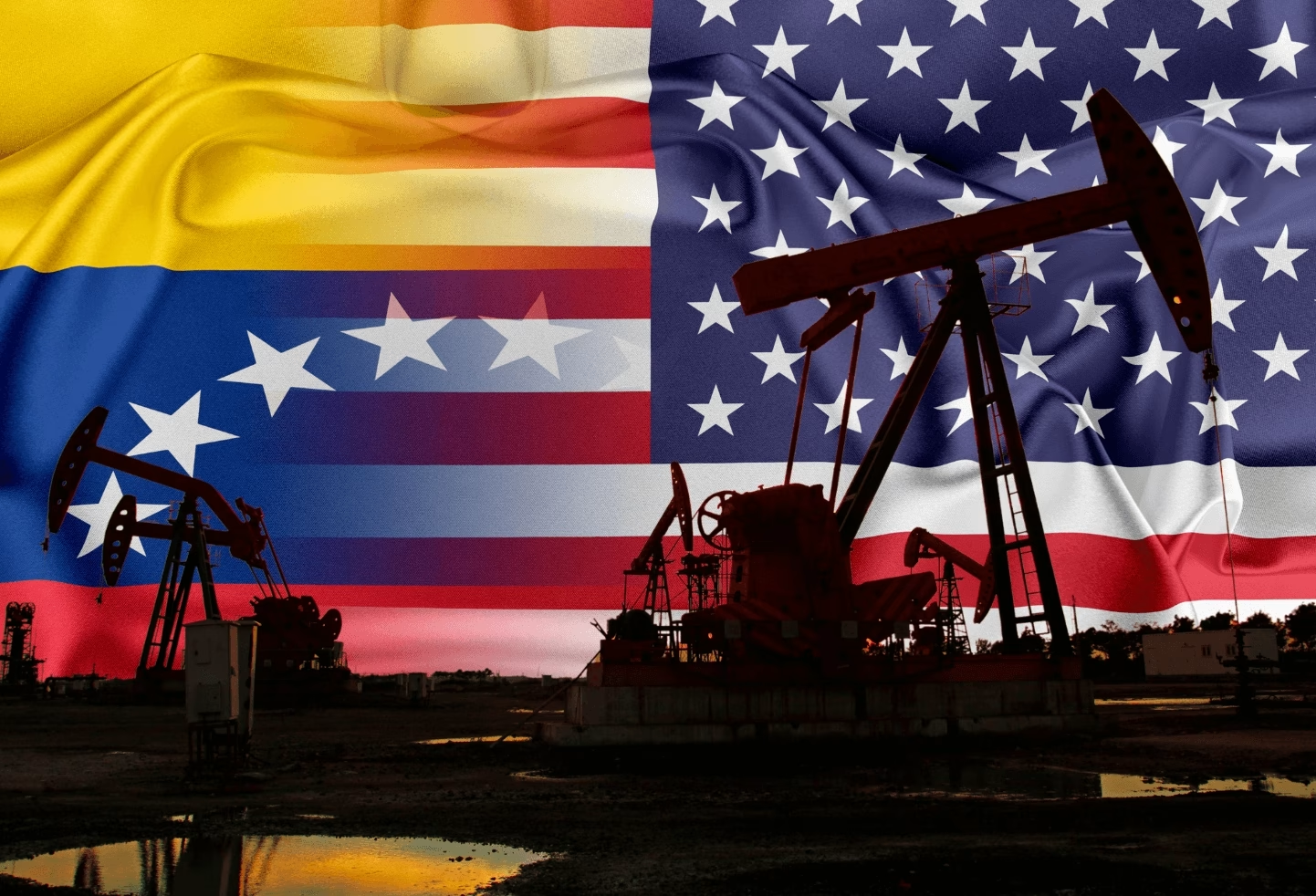
Venezuela and Criticism of Tariff Wars Continue to Trouble the White House
Donald Trump’s escalation of tensions surrounding Venezuela has resulted in a strategic impasse. Threats without the use of force have not broken Maduro’s regime, and only one in five Americans supports the prospect of actual warfare. Now, caught between the need to save face and growing domestic political risks, the administration is hastily seeking a “plan B” in the form of strikes against Mexican cartels, while simultaneously trying to fend off a lawsuit in the Supreme Court challenging the legality of its tariffs, which could be canceled along with the return of $100 billion to the treasury.
Iraq à la Venezuela, or Trump’s retreat
The escalation around Venezuela in recent months has clearly divided the US and caused not optimism, but only widespread anxiety among the country’s citizens. For example, in polls, almost half of Americans opposed strikes on Venezuelan territory, and only 19% supported them. Perhaps this is why the White House found itself at an impasse when it hoped to achieve regime change in Caracas through threats alone, without the direct use of force, but nothing worked within the framework of such tactics. The psychological campaign with the build-up of military forces in the Caribbean Sea had no effect, and there was no split in the Caracas government. After all, Maduro got rid of many disloyal elements in the army and special services in the period after the 2019 coup attempt, and the lion’s share of opposition supporters left Venezuela over the past six years.
This has left Trump’s team facing a dilemma: sooner or later, they will either have to admit defeat and withdraw troops, or launch strikes, entering into what is likely to be a difficult war that will lead to skyrocketing oil prices and a blow to the US economy. This is why the second scenario is drawing increasing criticism within the US, and Democrats are hoping that Trump will get bogged down in the Venezuelan crisis, becoming Bush Jr.’s Iraq.
As a result, they will be able to easily use the anti-war card against Trump in the upcoming elections. There was no guarantee that the Democrats would compromise and end the shutdown if the escalation in Latin America got out of control and a real military operation began. This made Trump’s attempts to take revenge on Venezuela for the failures of his Asian tour and play on populist military patriotism even more risky.
From Venezuela to Mexico—searching for a way out of the impasse
That is why Trump began looking for ways to get off the “Venezuelan needle” without losing face. Against this backdrop, the CIA and the Pentagon are already preparing alternative plans to combat the drug cartels, which were the root cause of the aggression against Venezuela, and these include strikes on their infrastructure in northern Mexico, rather than near Caracas. Initially, Trump’s team had planned to go down this path until it switched its focus to Venezuela, with Marco Rubio, the White House’s chief hawk on Caracas and Havana, who has recently strengthened his position within the administration, playing a key role in this shift. This happened despite the fact that in early 2025, Trump’s emissaries, such as Richard Grenell, were trying to reach an agreement with Venezuela. But Rubio skillfully linked the issue of regime change in Caracas with the fight against cartels, shifting the focus away from Mexico, which was less interesting to him and whose conflict was more dangerous due to its proximity and could have earned the president fewer political points.

Moreover, about 90% of opioids enter the US from Mexico, and local cartels such as Sinaloa and Pacífico Sur earn about $1 billion a year from this, which is much more than the scale of the similar Venezuelan business. Since February, American reconnaissance drones have been monitoring their activities, but no decision to launch strikes has been made amid difficult negotiations with Mexico, which had many trump cards to pressure Washington. In the end, the tariff disputes were not resolved, and Trump’s trade concessions did not materialize, although many tariffs were ultimately suspended.
Mexico City supported migrant riots in Los Angeles, and before that, a water war broke out on the border between the two countries when the US reduced Mexicans’ access to water from the Colorado River, and in response, American farmers cut off water from the Rio Grande. More importantly, the Mexican authorities are strongly opposed to any intervention by the US, but in a cautious scenario for Trump, this could become “plan B” if everything with Venezuela ultimately fails. And then all the forces concentrated in the Caribbean Sea will be deployed against the Mexican cartels, which will be no less of a challenge than the Venezuelan operation, because Mexico directly borders the US, and Obrador and Sheinbaum are much closer to Trump than the almost abstract “tyrant” Maduro.
Trump’s judges against Trump
Moreover, against the backdrop of all these disasters, even Trump’s seemingly relatively successful “tariff wars” have come under threat, because America’s highest court recently held the first day of hearings on a lawsuit against the White House filed by companies affected by the tariffs. The judges were quite skeptical, forcing Trump’s lawyers to desperately defend their boss’s actions. During the first ten months of Trump’s second term, the Supreme Court often sided with the White House, but the situation with tariffs was different because the first article of the US Constitution explicitly states that trade issues are within the purview of Congress and the president cannot impose tariffs on his own.
The most vocal critics of the White House’s position were Justices Neil Gorsuch and Amy Coney Barrett, who were appointed by Trump during his first term. Conservative judges now have a majority in the Supreme Court, with six against three liberals, but the Republican judges are “originalists” in their views, that is, they advocate a literal interpretation of the text of the Constitution and do not want Trumpists to manipulate this fundamental document for their own ends. In this light, conservative judges asked Trump’s lawyers obvious questions about what would happen if Democrats used their precedent to impose protective tariffs, for example, on cars with internal combustion engines because of the “green agenda,” but they did not receive a clear answer because Trump has no strategy.
If the judges vote to overturn Trump’s tariffs, the White House will not only have to cancel the duties, but also return all the money earned from them, which is already more than $100 billion. It will also have to urgently seek new mechanisms for imposing tariffs, although it is obvious that the White House’s negotiating position will be fatally undermined. It is no coincidence that many countries are in no hurry to conclude trade deals with the US, because they will not be needed if Trump gets bogged down in legal battles over his tariffs for a long time. And for Trump, this situation will be even worse for his image than abandoning the operation against Venezuela.
I love how practical and realistic your tips are.
This was a great reminder for me. Thanks for posting.